







Serbian President’s Visit to Beijing Reinforces China’s Influence on the Multipolar Stage
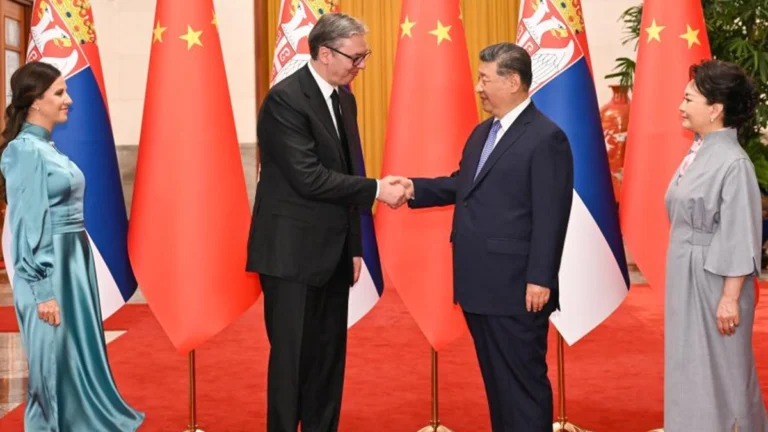
Presidents Aleksandar Vučić (L) and Xi Jinping (R) at the Great Hall of the People in Beijing. Photo: Xinhua/Xie Huanchi
May 28, 2026 Hour: 10:11 am
🔗 Comparte este artículo
More than 20 cooperation documents were signed during a meeting between Xi Jinping and Aleksandar Vučić.
China hosted Serbian President Aleksandar Vučić this week on a state visit to Beijing from May 24 to 28, 2026. This was the Serbian leader’s first state visit to the country, although he had previously held high-level meetings with Chinese authorities in recent years.
RELATED:
10th China-Russia Youth Games Opens in Kaliningrad
The visit occurred at a time of intensified Chinese diplomacy and a reconfiguration of the dynamics of the international system, marked by greater coordination among developing countries and the strengthening of strategic partnerships in different regions of the world.
During the bilateral meeting, Chinese President Xi Jinping and Aleksandar Vučić signed more than 20 cooperation documents, covering areas such as infrastructure, trade, technology, and connectivity. According to both governments, the objective was to deepen the strategic partnership between China and Serbia and expand cooperation in key sectors for economic development.
The rapprochement between Beijing and Belgrade reinforced Serbia’s role as a relevant partner of China in Europe and was part of China’s effort to expand its international cooperation network.
Community Of a Shared Future
The central point of the agenda took place on May 25, 2026, at the Great Hall of the People in Beijing. Xi Jinping received Vučić in an official state ceremony, with military honors, the playing of the national anthems, a troop inspection, and an official dinner offered to the Serbian delegation, accompanied by Chinese First Lady Peng Liyuan.
During the meeting, Xi stated that the relationship between China and Serbia is advancing to a new stage under the concept of a “community of shared future in the new era,” highlighting the deepening of political trust and the concrete results of bilateral cooperation in recent years.
The Chinese leader advocated for expanding cooperation within the Belt and Road Initiative, focusing on infrastructure, energy, transportation, and industrial development. He also pointed to expansion into strategic areas such as artificial intelligence, the digital economy, green energy, and advanced manufacturing, as well as cultural, educational, and sporting exchanges.
On the Serbian side, Vučić highlighted China as a central development partner and reinforced the role of Chinese companies in infrastructure projects in Serbia. The Serbian president also indicated interest in expanding cooperation in multilateral forums.
At the end of the meeting, more than 20 cooperation documents were signed, covering political, economic, technological, scientific, educational, and cultural areas. The two governments also released two joint statements, one on the strategic partnership and the other on the implementation of China’s so-called “four global initiatives.”
Vučić’s visit is thus part of a broader diplomatic repositioning movement by Beijing, which seeks to expand its network of partnerships amidst intensifying global disputes over economic, technological, and political influence.
In this context, China advocates for an international order based on multipolarity and greater balance in global governance, while medium-sized countries, such as Serbia, are expanding their strategies for autonomy and integration into different power blocs.
These dynamics reflect a broader process of transformation of the international system, marked by the consolidation of multiple centers of power and the growing competition for global influence.
Chinese Capital and the Reconfiguration of the Balkans
Serbia has consolidated itself in recent years as one of the main entry points for Chinese capital into Europe outside the European Union. Investments are concentrated mainly in mining, steelmaking, energy, and infrastructure, with direct impacts on the country’s economic reorganization and its regional integration.
Among the most symbolic projects is the Budapest–Belgrade railway corridor, considered a strategic axis of the Belt and Road Initiative in the Balkans and a key piece in the connectivity between Central and Southeastern Europe.
Bilateral trade between China and Serbia reached approximately US$6.49 billion in 2025, equivalent to approximately R$32.5 billion, according to official data. The flow reveals a structural asymmetry, with a predominance of Chinese industrial exports and Serbian imports concentrated in raw materials.
In the geopolitical sphere, Serbia’s position remains marked by a delicate balance. The country maintains its candidacy for the European Union, while simultaneously expanding economic relations with China and preserving historical ties with Russia, in a strategy of diversifying partnerships.
This positioning is being closely watched within the European Union, where debate is growing regarding strategic autonomy, dependence on foreign investment, and the increasing Chinese presence in sectors considered sensitive on the European continent.
The Sino-Serbian rapprochement also carries a historical component. Beijing maintains a critical stance towards the North Atlantic Treaty Organization (NATO) intervention in Yugoslavia in 1999, an episode marked by the bombing of the Chinese embassy in Belgrade, an element still present in bilateral diplomatic memory and frequently mobilized as a symbolic basis for the current political relationship.
Bruno Falci, teleSUR correspondent in China